
Chatty Corner – The Guide
For Educafe volunteers and others interested in setting up an English conversation group
What is The Chatty Corner?
By Margaret Neville, Chatty Corner Manager
The Chatty Corner is a space where people who want to learn English can practise their spoken English, make new friends, share experiences and expand their knowledge of life in the UK in order to increase their sense of belonging.
♦ Chatty Corner visitors are called “chatters” rather than students (which implies more formal learning) or “visitors” (which does not differentiate them from other Educafe users).
♦ There is no registration process and chatters can arrive and leave at any time for as long as they want while Educafe is open.
♦ Chatters do not need to be there at the beginning or stay until the end but maybe do stay for the whole 3 hours we’re open!
♦ Chatty Corner exists because there is a shortage of English lessons for adult non-native speakers and we wanted to create an informal space where spoken English was the focus rather than literacy skills.
Who is the target audience?
Adults from West Berkshire who do not have English as a first language attend.
♦ It does not matter what level they are, where they come from or how long they have been here.
♦ Beginners benefit enormously as it is beneficial to learn some spoken language before embarking on literacy skills (which are the focus in the classroom).
♦ Improvers and advanced speakers also benefit greatly as it gives them the opportunity to practise speaking in a relaxed and informal atmosphere and about topics which are both relevant and useful.
♦ Older residents and those with low literacy skills due to lack of education in their native country can also benefit considerably by learning speaking and listening as this will give them easier access to reading and writing skills.
♦ Many chatters are refugees and asylum seekers. There are large groups from Afghanistan, Ukraine and Hong Kong. There are also chatters from India and other Asian countries, Africa, South America and some European countries too.
♦ The majority are female but there are many male chatters too. The ladies are often mothers of young children and they are able to bring them if they are not at school. There are chatters of all ages; from 19 to around 80.
♦ If a chatter is under 19, safeguarding awareness needs to be taken into account.
Origins – How did it start?
The Chatty Corner started because the one of the founders of Educafe who is also an ESOL teacher saw the need for an informal space to practise speaking and listening as well as having the opportunity to make new friends, become part of the community and find out about life in the UK.
[See Podcastsfor detailed background about Educafe and Chatty Corner]
Experience has shown that practising real life speaking and listening in a classroom situation is difficult due to time restraints and curricula. It was clear that by improving oral skills and finding out more about daily life here, the chatters’ lives would be more meaningful.
The volunteers in the Chatty Corner are able to share their knowledge and give the chatters a wide variety of advice on many issues such as cultural events, news items, running a household, healthcare, education and more. If the volunteers do not know the answer to a question, they will endeavour to signpost the chatter to an organisation who can help.
Evolution – How has it developed over time?
When the Chatty Corner started in June 2022, there were only a handful of chatters. Sometimes there were more volunteers than chatters. We did not have many resources and we were short of space. By the time we moved into Newbury Library in January 2023, we regularly had around 30 chatters and there are now around 50 or more every week.
In January 2023 a Chatty Corner Manager was appointed. This is currently a voluntary role. This meant that someone was overseeing the running of the area and ensuring some consistency as necessary. The manager is responsible for drawing up a rota and allocating a group of chatters to a volunteer. We began to build up resources to help the volunteers initiate conversations.
The audience and purpose of the Chatty Corner is still very much the same as it was at the start. Sometimes participants (volunteers and chatters) want to introduce more literacy skills but the focus must always be speaking and listening.
Who & what is involved?
Volunteers
The Chatty Corner Manager is helped by over 30 volunteers. They do not all come every week and they do not need to stay for the whole three hours. The volunteers come from all walks of life. Some are or were teachers but that is by no means essential. The volunteers need to have English as a first language or be proficient in it, enjoy conversation, be able to share knowledge about life in the UK and want to help the chatters improve their English.
Training
Volunteers do not need any specific job training although some is useful. There is printed guidance for starting in the Chatty Corner as well as help to get the chatters talking. Training is often given on using the resources. This can be on an ad-hoc basis or sometimes in a group if time permits. There is also safeguarding training and advice.
Administration and operational support
There is an administrator employed by Educafe who oversees the onboarding of the volunteers, ensures that their personal information is safely stored according to data protection laws and that they all have up to date DBS checks.
Educafe also offers more formal English lessons at other times and locations which our chatters are signposted to.
What is involved in delivery?
The Chatty Corner is part of Educafe’s community cafe which takes place every Wednesday in term time from 11am to 2pm at Newbury Library.
Space & equipment
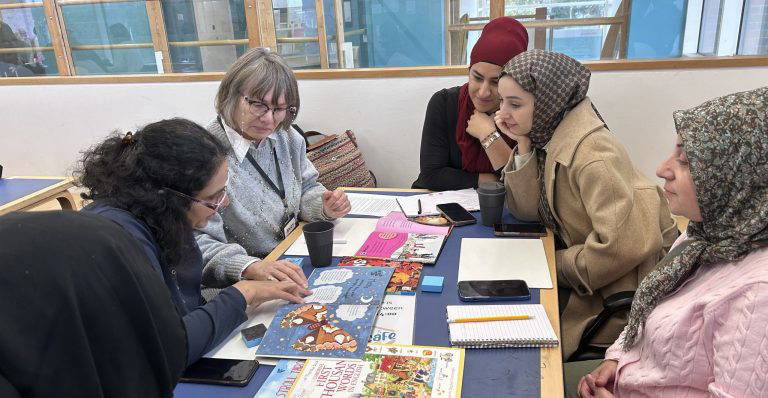
There is a large area reserved for it with about 20 desks and as many chairs as we need week-to-week.
A volunteer rota system
The manager creates a rota for the volunteers, based on their availability, on a half termly basis. The session is split into two slots of one and a half hours each. Some volunteers stay for both slots and some overlap a bit if the set times are not convenient. Since the chatters all arrive at different times, this fluidity works well.
Allocating volunteers & chatters based on level of English
Each volunteer (one per table) is allocated a group of 5-6 chatters by the manager. The intention is usually to keep the levels fairly similar on a table although this is not essential. Sometimes a weaker chatter will want to be with someone more fluent from their own country and this can work well for explanations and encouragement. The emphasis is on informality and groups may change during the session. As new chatters arrive, they may be added to a group and it is possible that some chatters will leave at any time.
Awareness & sensitivity
It helps if the manager is aware of the chatters’ requirements and the volunteers’ preferences although this is not always possible. They need to be sensitive to any issues arising from the group and take any necessary action to rearrange it as necessary. For example it may be that one chatter is dominating the conversation or that one is not joining in at all. Sometimes a volunteer might be struggling with a large group or with a chatter who has a sensitive issue to discuss. In all these cases it is usually possible to make new groups.
Refreshments & movement
Teas and coffees are served for the duration in the Community Cafe; both chatters and volunteers are free to go to the cafe at any time. In fact the volunteers are encouraged to move around with their group. They can look for books in the library, go and chat to other people and even walk around town if they want to.
Resources & topics of conversation
There are a number of resources available to the volunteers, all of which encourage conversation; flash cards, picture dictionaries, quiz type questions and board games to name a few. Some volunteers bring their own resources and material.
We encourage conversations to be about a range of topics and there are few limitations. It can be about different cultures, hobbies, education, the news, current events locally and nationally, families, going to the doctors, talking to school teachers and so on. It is usually better to avoid issues such as conflicts in their own countries, talking about how they arrived or why they are here. However, these topics do arise and the volunteers are encouraged to be sensitive and to report to the safeguarding lead if they have any concerns at any time.
The magic ingredient in the Chatty Corner is the volunteer. Their dedication is obvious and the chatters both love and appreciate them.
How do we measure impact?
- How do we measure impact?
The fact that the chatters return week on week is, alone, evidence of the impact of the Chatty Corner. Every week there are at least 50 chatters and it is likely there would be more if there was more space and more volunteers.
The Chatters regularly tell us how much they appreciate the service and how much it benefits them both in terms of language and of well-being. It is a regular occurrence to meet a new chatter who looks somewhat worriedbut who will leave at the end with a huge smile having made new acquaintances and been encouraged to speak, if only a little. They always come back again.
One chatter (I’ll call her K) who is probably around 50 and suffered a stroke several years ago has tried attending college classes but made little progress beyond pre-entry. She can no longer be funded there because of lack of progress. She has been coming to the Chatty Corner for over two years and has made some language progress particularly with listening. However, more importantly, her sister who speaks good English told us that K has never been happier since she feels involved and valued because of the support she receives from the volunteers.
Another chatter, a young Indian mother (S) came to us with intermediate English but hugely lacking in confidence. S was a qualified nursery nurse in her country but was unable to transfer her skills and was having trouble finding work. After about a year with us, we encouraged her to apply to a local nursery school and she was successful. They have now offered to train her and she will be able to gain the necessary qualifications to work in the field she loves.
Visit Case Studies
Listen to Podcasts
Access more support in All About Volunteers and Resources